



FEBRUARY 2010:
PREPARING TO START THE POINT: Serving and Receiving
I couldn’t help but take note of the meticulous pre-pitch routine of New York Yankee veteran, always clutch in the big moments Andy Pettitte (also the winningest pitcher in MLB in the last decade!), during the 2009 World Series. At the same time it was equally interesting to observe the pre-hit routines of the star players who were facing him. The idiosyncratic patterned rituals, always performed move-by-move in precisely the same order, collectively leading up to the very fleeting moment when the ball is released at high speed, and the batter attempts to put it in play (or out of play – home run) from a mere 60’6” away, or choose not to. It’s the classic mano-a-mano moment of truth.
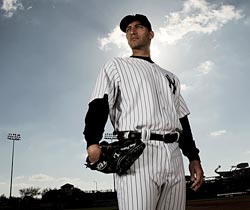 Upon receiving the ball from
the catcher for the next pitch, Pettitte immediately proceeds to immerse himself in his intricate ritual – unique to him – leading up to his next delivery, all aimed at creating a confident and
familiar comfort zone from which to throw.
Upon receiving the ball from
the catcher for the next pitch, Pettitte immediately proceeds to immerse himself in his intricate ritual – unique to him – leading up to his next delivery, all aimed at creating a confident and
familiar comfort zone from which to throw.
First, catching the ball from the catcher. Then the same every time round about, no hurry walk back to the mound and then onto the rubber. The multiple tugs at different parts of his uniform and cap. The shoulder shrugging. The ball in glove placement below his sight line and in front of his body while reading the sign from the catcher. The deep breath. The focused moment of visualizing the intended pitch’s speed, trajectory, and location. And finally, the coiling up of his body and the fully committed, no self-doubt release of the pitch. This all taking place simultaneously with the hitter performing his own rituals to ready himself.
Sound familiar? The exact same scenario takes place in tennis between the server and the receiver or returner, and in about the same time frame. At the tour level the depth of these rituals are readily apparent – think Rafael Nadal’s shorts “tug,” or the Novak Djokovic’s extended ball bouncing to name just two.
These guys do not dare leave home without them, but do not confuse this with superstition. Not the same! Yet, these kinds of rituals, which are also absolutely necessary for you to perform your best before serving or returning, are often vague and inconsistent in club players at best, and in between point time, worse yet, is mostly picking up balls and not much more in terms of preparation to play the next point.
Rituals are defined by Webster as “a customarily repeated act or action or series of acts.” They are very much acquired habits, that in sports, and life, create a sense of well being and purpose as one prepares to embark on a given activity or task.Do you not brush your teeth in the same fashion every single time? Do you not put your clothes on in the same order every single morning to start the day? These learned habits are ritualistic in nature, and are most beneficial in life and especially in sport where performing finite motor skills under pressure is the order of the day.
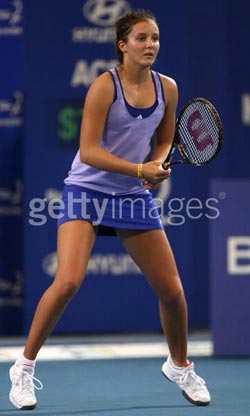 On the court, once any given point ends, the preparation leading up to a positive start of the next one begins with self-belief for both the server
and the returner. From the server’s perspective it starts with taking one’s time gathering the balls.
On the court, once any given point ends, the preparation leading up to a positive start of the next one begins with self-belief for both the server
and the returner. From the server’s perspective it starts with taking one’s time gathering the balls.
Do not rush mindlessly helter skelter from point to point. Haste still makes waste in any venue. Always exhibit a positive body language – those observing should not be able to discern whether you have won the point or not! At the same time the process of deciding upon the speed, spin, and trajectory over the net - by thinking in pictures, or by visualizing your intended “flight plan” – begins and is finalized for your first serve as you approach the line.If you’ve seen any televised tennis recently the computerized line calling system, Hawkeye, perfectly illustrates the path of any ball in question through a thick yellow line, with the court as background (not coincidentally the ball color), from shot in question that traces its trajectory from impact to the in-or-out bounce point, and then continues on a bit farther after the bounce illustrating the shot’s angle of ascent as well.
Then there’s the settling-in to your serving position, the deep breath to relax, and further visualization reinforcement – picturing a successful serve before you launch it. Now the rhythmic ball bouncing to relax further – please, don’t do Djokovic – followed by the ball-on-racket rhythmic rocking of some kind to get the left and right arm in sync along with the entire body, and the final look across the net visualization before launching one’s service motion with total commitment or zero self-doubt.
The receiver’s routine is very much the same. The gathering of balls for the server as necessary. The walk-up to the desired returning position at a comfortable, easy pace. The energizing in place – the revving of the engine if you will – by skipping laterally foot-to-foot. Then the settling into the return position featuring a rhythmic side-to-side upper body movement – including a slight shifting of weight from foot-to-foot that mimics the hip-shoulder rotation needed to prepare the racket once the serve is actually struck. Simultaneously, visualizing both the intended return – flight plan again - from the forehand wing, and from the backhand side as well.
Embrace the fact that the serve and the return are the only shots that you have plenty of time to pre-visualize, all others are on the fly - “Chess on the run,” according to the late novelist and tennis enthusiast David Foster Wallace.
These actions and thoughts take place, ideally, in precisely the same sequence on each and every point, i.e. the term “rituals.” They will pay big dividends if you develop your very own routines and stick with them religiously – lean on them, believe in them!
Take a moment sometime soon and observe the best ball strikers on Earth – see Tennis Channel or, better yet, attend the pro tour event in Miami in a few weeks! - going through their own elaborate and idiosyncratic rituals prior to starting their points.
Take special note of the always positive in-between-point body language and the on-a-mission game faces! Call it a cheat sheet of sorts to bolster your ball striking game and enhance your overall chance for success mentally-emotionally as well.
Ready. Set. Go!
Questions and comments are welcome at anytime for all tips present and past via email.
This Tip of the Month is copyright© by Jak Beardsworth Tennis. All rights reserved. Copies may be made only with the permission of and by Jak Beardsworth. Contact him here.
Tips Archive
- May, June, 2013 JUST TALKING HEADS OR MORE [read more]
- March, April, 2013 SELF-TALK: Good, Bad, or Indifferent [read more]
- January, February, 2013 BOOK-A-MILLION: Do Tennis Players Read? [read more]
- December, 2012 THE KEY TO TOUR LEVEL BALL STRIKING: And How to Learn It [read more]
- November, 2012 ARE YOU A THUDDER, A TWANGER, OR A PINGER: Racket Dampeners [read more]
- September, October, 2012 SMART SHOTS [read more]
- July, August, 2012 TEN TOP STRESS REDUCERS [read more]
- June, 2012 MAKING YOUR LESSONS STICK [read more]
- May, 2012 THE IMPOSSIBLE: Accelerating and Decelerating Simultaneously [read more]
- April, 2012 PLAYER DISCONNECTION [read more]
- March, 2012 BENDING THE SERVE IN [read more]
- February, 2012 UNDERSTANDING TERMINOLOGY: Drill vs Clinic vs Team Practice [read more]
- January, 2012 PLAYING SCARED? [read more]
- December, 2011 CUTTING OFF THE ANGLE…VERTICALLY [read more]
- November, 2011 WHY COACHING? [read more]
- October, 2011 THE EASY BALLS ARE NOT EASY [read more]
- August/September, 2011 NEVER TOO LATE FOR OLDER DOGS [read more]
- June/July, 2011 HARD COURTS, SOFT COURTS, and YOUR BODY'S ADAPTATION [read more]
- April/May, 2011 JAW DROPPNG [read more]
- March, 2011 CLUB DOUBLES' INCREASINGLY MISSING LINK [read more]
- February, 2011 TIP 2 | POOH POOHING DOUBLES STRATEGY SESSIONS [read more]
- February, 2011 TIP 1 | CLAY TO HARD, HARD TO CLAY [read more]
- January, 2011 ICING THE SERVER WHEN RECEIVING IN THE BIG MOMENTS [read more]
- December, 2010 JOHN ISNER’S “GOOD MISS” [read more]
- November, 2010 THE MOST NEGLECTED SHOT IN THE GAME [read more]
- October, 2010 BALL BOUNCING and the SERVE [read more]
- September, 2010 TAKE YOUR EYE OFF THE BALL [read more]
- July-August, 2010 SUMMER SCHOOL COURTSIDE CRIB SHEET [read more]
- May-June, 2010 THE 2-HANDED JUMP BACKHAND: The Dumbest Shot in Tennis [read more]
- April, 2010 THE STANDING AROUND SYNDROME [read more]
- March, 2010 THE ELUSIVE SERVICE TOSS [read more]
- February, 2010 PREPARING TO START THE POINT: Serving and Receiving [read more]
- January, 2010 DEBUNKING THE MODERN GAME [read more]
- December, 2009 RELAX – IT'S JUST A RALLY BALL [read more]
- November, 2009 DEFEATING THE POACHER [read more]
- October, 2009 PRACTICE, PRACTICE, PRACTICE [read more]
- September, 2009 SERVING SUCCESS: Warming-Up vs Match Play [read more]
- August, 2009 THE SPLIT STEP: Defending the Court, Rushing the Net, and More [read more]
- July, 2009 THE THIRD GROUNDSTROKE [read more]
- June, 2009 HOW MANY HANDS DOES IT TAKE? [read more]
- May, 2009 THE MOST IMPORTANT SKILL [read more]
- April, 2009 PLAYING IN THE FLORIDA WIND [read more]
- March, 2009 Letting them Play for Peak Performance in Clubland [read more]
- February, 2009 SUPPORTING YOUR GAME [read more]
- January, 2009 RESPECTING THE GAME: Top 10 Do's & Don'ts [read more]
- December, 2008 Getting the Warm-up Right [read more]
- November, 2008 Visualize...Realize: The Mind Body Connection [read more]
- October, 2008 Reading Their Mail [read more]